


Inside Milan’s legendary football cathedral, where 2 eternal rivals share 1 extraordinary home
There are places you visit, & there are places you feel. San Siro belongs firmly to the latter. My 9:30am appointment for the San Siro Stadium Tour was easily kept. The legendary stadium was less than 10 minutes on foot from my apartment, so there was no frantic dash, no Milanese transport drama, just a leisurely walk towards what has, for generations, been one of football’s most revered stages.
I arrived to find quite a crowd already waiting for the same tour.
Our guide was Simione, or something very close to that. I hope I got it right. He was quick to point out that he wasn’t Simeone, the name instantly familiar to football followers because of the former Inter player.
A little laughter. A little banter. And then, we stepped into history.
WELCOME TO SAN SIRO
Officially, this magnificent footballing monument is the Stadio Giuseppe Meazza, named after Giuseppe Meazza, one of Italy’s great footballers.
San Siro, strictly speaking, is the district of Milan in which the stadium stands. But names have a way of acquiring lives of their own, & around the world, this place is simply, & almost universally, known just as San Siro.
The 1st thing that strikes you is the sheer scale of it. Then, the colours.
On this particular morning, blue seemed to have the upper hand. Inter was preparing for an upcoming fixture, & the stadium was beginning to wear its Nerazzurri identity.
That is one of the fascinating things about San Siro: whoever is playing at home determines the mood, colours & visual personality of the place.
One stadium. 2 clubs. 2 loyalties. 2 fiercely guarded identities. Red & black for AC Milan.
Blue & black for Inter Milan. And somehow, both call this same extraordinary place home.
WHERE THE PLAYERS SPEAK
Our 1st stop was the Mix Zone, that familiar but rather magical space where footballers stop after matches to face the press.
You know the pictures. The microphones. The television cameras. The exhausted players. The hurried questions. The occasional diplomatic answer after a painful defeat.
Standing there, away from the tv screen & actually inside the space, I suddenly appreciated just how much theatre takes place in those few square metres. And then came the dressing rooms.
THE RED ROOM
We entered AC Milan’s locker room 1st.
There is something almost theatrical about entering the dressing room of a club whose history is so deeply woven into European football. AC Milan was founded in 1899 by an Englishman, Herbert Kilpin.
And the story behind the famous red-&-black colours is wonderfully dramatic. Kilpin is remembered for declaring: “We will be a team of devils. Our colours will be red like fire & black to invoke fear in our opponents.” Now, that wasn’t merely choosing colours for a football shirt.
That was choosing an identity. A warning. A philosophy. Red like fire. Black to inspire fear. You almost understand the club before seeing a single trophy.
THEN THERE IS BLUE
The Inter dressing room tells another story. The 2 rooms are noticeably different. AC Milan’s red dressing room features individual seats, while Inter’s blue room has a more integrated seating arrangement.
Small details, perhaps.
But when you are standing there, surrounded by the history & symbolism of two clubs whose rivalry has survived more than a century, even the arrangement of a seat begins to feel like part of the story.
And then came one of the more fascinating chapters.
THE NIGHT INTER WAS BORN
Inter was founded in 1908, after 44 members broke away from AC Milan following disagreements over restrictions within the club, particularly concerning foreign players.
So they created another club. Inter. There is something deliciously dramatic about the history of football when you strip away the statistics.
A disagreement. A rebellion. A group of men. A new club. And more than a century later, that decision has produced one of football’s most famous rivalries. The irony? They still share the same stadium.
STARS ON THE SHIRT
The numbers add another layer to the rivalry. Inter’s 20 Serie A titles have earned the club its 2nd star. AC Milan, with 19 Serie A titles, wear 1 star.
But when Europe enters the conversation, the balance shifts. AC Milan have won the European Cup/UEFA Champions League 7 times. Inter have won it 3 times. And Juventus, Italy’s domestic powerhouse, have claimed 36 Serie A titles (Scudetto). Football, after all, has a long memory.
THROUGH THE TUNNEL
Then came the tunnel. This was one of those moments when the tour stopped feeling like a tour.
You are walking through the same passage that generations of footballers have walked through before emerging into the roar of tens of thousands of people.
The lighting is changed according to the home team. Blue when Inter is at home. Red when Milan is. It sounds like a small detail. It isn’t.
Because suddenly you realise that everything here, the colour, the light, the shirt, the sound, even the walk to the pitch, is designed to build anticipation.
And then you emerge. The pitch opens before you. And you understand. This is why footballers get goosebumps. I was in awe! I imagine myself on a match day. I had missed the Sunday match by whiskers!
76,000 vociferous VOICES
San Siro accommodates roughly 76,000 spectators. Seventy-six thousand people. Imagine that many voices rising together.
Imagine a derby. Imagine the 1st goal. Imagine the tension before a penalty. Imagine the entire stadium turning into one living, breathing organism.
There are also seats so close to the pitch that you can almost feel the game rather than merely watch it.
Some of those privileged positions are not sold to the general public but reserved by strict invitation for families & friends of players.
Then there are the VIP sections, where the price of entry can run into the thousands of euros for a single match.
The red seats closest to the VIP areas are among the most expensive.
The orange seats opposite on the other side, interestingly, offer a comparable broad view of the action at a much friendlier price.
And then there are the green & blue sections, each carrying its own allegiance & meaning. At San Siro, even where you sit can announce who you are.
THE MUSEUM OF MEMORY
By Gate 14 is the museum. And this was another delight. The rivalry doesn’t disappear inside the museum. If anything, it becomes more fascinating.
The red & blue histories are distinctly represented through old jerseys, trophies, photographs & memorabilia. You see the players who became legends.
The shirts that became iconic. The trophies that turned seasons into history. And suddenly, the names you have known all your life stop being names on tv.
They become part of a physical story. A shirt behind glass. A photograph. A trophy. A memory.
THEN I MET THE SHOP
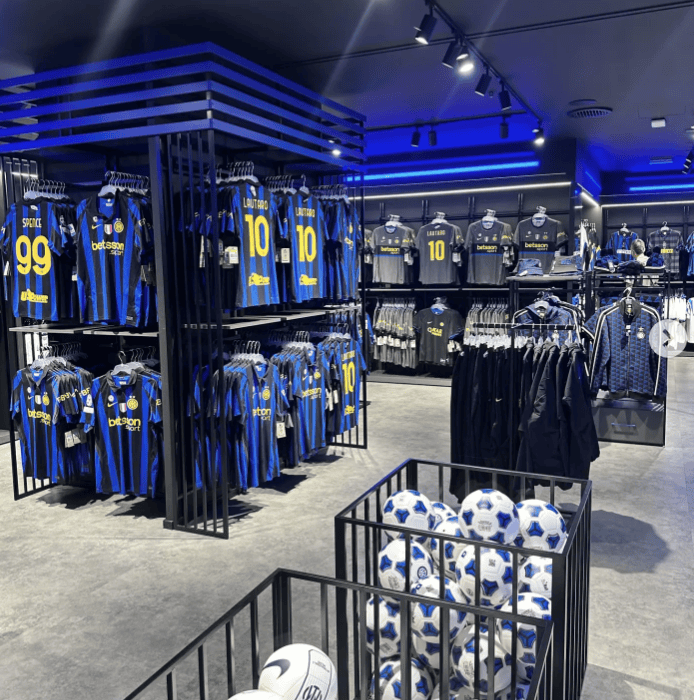
And then, of course, there was the official store downstairs by Gate 14.
Beautifully done. Really beautiful. Everything was sharp, polished & unmistakably Milan. Red to the left & blue to the right.
But the prices? Ah!
Let me just say that the beauty was considerably more affordable from a distance. I saw a badass coffee table book I wanted but it was €300 Euros plus… Hmmmmm…
And, somewhat to my own surprise, I thought the blue section (Inter side of the store) looked a little more attractive. May be it’s just the blue colour…
I repeat: I still prefer AC Milan though. Let nobody misquote me!
THE STADIUM THAT MAY DISAPPEAR
Perhaps the most poignant part of the entire visit was learning about San Siro’s future.
Plans are in place for a newer, more modern stadium, with construction expected to begin in the area in front of Gate 8. The project is expected to take years, after which the current stadium would eventually come down.
And that is difficult to contemplate. Because this is not simply concrete, steel & seats.
This is where generations have celebrated, cried, fought, won, lost & created memories. This is where football history has happened.
One day, the old giant may be gone. But the memories will remain. RED. BLUE. MILAN.
As I walked back out of San Siro, I found myself thinking about what makes the place so special. It isn’t merely the architecture. It isn’t even the trophies. It is the emotion.
The knowledge that 2 clubs with radically different identities can share 1 magnificent home & still fiercely defend their own little kingdoms.
Red & black. Blue & black. Milan & Inter. Fire & rivalry. History & ambition.
And somewhere in the middle of it all stands this enormous old cathedral, watching generation after generation come & go.
I came to San Siro for a stadium tour. I left having walked through a piece of football history.
And perhaps that is the magic of places like this. You don’t merely visit them. For a few precious hours, they let you become part of their story.