

The political fog has finally lifted.
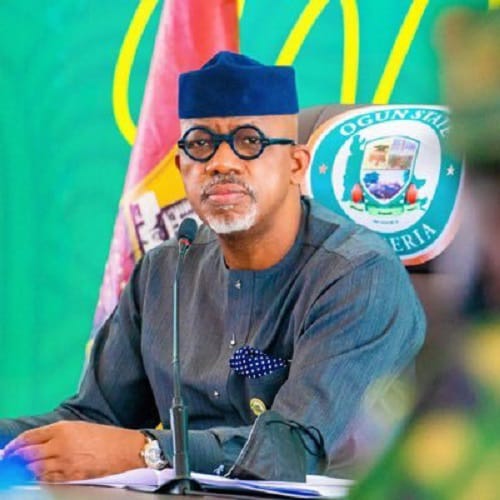
After months of subterranean maneuvering, delicate calculations, strategic alignments, silent compromises, bruised ambitions, & intense power negotiations within the ruling APC, Governor Dapo Abiodun has now effectively secured the most critical half of his immediate political future, the party ticket to contest for the Ogun East Senatorial seat.
And in Nigerian politics, especially within the dominant structures of the APC in Ogun State, securing the party ticket is often the hardest battle itself.
Yes, technically, the general election still lies ahead. Yes, candidates from other political parties would still emerge to challenge for the seat. Democracy demands that formal ritual. But realistically speaking, the pathway before Governor Abiodun now appears extraordinarily favourable. Barring a dramatic & highly improbable political upset, the current occupant of Government House, Oke-Mosan, is overwhelmingly likely to transition smoothly from Executive Governor to Distinguished Senator of the Federal Republic of Nigeria.
The numbers favour him.
The structure favours him.
The ruling party machinery favours him.
Incumbency influence favours him.
And perhaps most importantly, the dangerous internal turbulence that could have truly unsettled his senatorial ambition now appears largely neutralized.
The one political figure capable of significantly rattling the Governor’s calculations was always going to be Otunba Gbenga Daniel, former Governor, incumbent Senator representing Ogun East, & one of the most deeply entrenched political architects in the entire Ogun East axis.
If Senator Daniel choses the path of open confrontation, rebellion, or defection to another formidable platform, the political equation may have become significantly more complicated.
But experience teaches seasoned politicians when to escalate & when to preserve future relevance.
Though visibly bruised/upset by the internal scheming that edged him aside, Senator Daniel would ultimately chose political maturity over destructive warfare.
Rather than detonating the house, he would opt to preserve the structure. Such restraint in Nigerian politics is neither accidental nor unrewarded. Power negotiations rarely end without compensatory balancing somewhere behind the curtains, whether through future political accommodations, strategic nominations, appointments, or negotiated influence.
Interestingly, Governor Abiodun himself also had to concede something substantial in return.
His own acceptance of Senator Solomon Olamilekan Adeola aka Yayi, as the likely successor in the Ogun governorship succession arrangement became the stabilizing sacrifice that ultimately unlocked his senatorial pathway. In politics, every ambition exacts a price. No major victory comes untouched by compromise.
And now that the most sensitive political chessboard appears largely settled, another matter of even deeper historical significance urgently demands attention.
The throne.
Or more precisely, the thrones.
For beyond electoral politics & senatorial calculations lie 2 unresolved royal transitions whose continued uncertainty now hangs heavily over both Ijebuland & Iperu-Remo.
And now that the political intrigue surrounding the Governor’s immediate future has substantially calmed, attention inevitably shifts to the next profound question:
When exactly would the coronations happen?
Because what once may have been partially slowed by political caution, overlapping ambitions, or strategic hesitation can no longer convincingly hide behind those same uncertainties.
The royal questions now stand exposed in full public view.
The 1st, & unquestionably the weightier in cultural magnitude, is the emergence & coronation of a new Awujale of Ijebuland.
The transition of His Royal Majesty, Alaiyeluwa, Oba Sikiru Kayode Adetona in July 2025 did not merely create a vacant stool; it closed one of the grandest chapters in Yoruba traditional history. Oba Adetona was no ordinary monarch. He was a phenomenon. A sovereign institution. A traditional ruler whose influence transcended palace walls into governance, jurisprudence, intellectual discourse, political mediation, & national moral authority.
For 65 extraordinary years, he occupied the throne of the Awujale.
An entire generation of Ijebus was born, matured, grew old, & passed through life under one monarch.
Such longevity creates emotional permanence.
It also makes succession psychologically monumental.
Naturally, replacing a titan of that magnitude was never going to be mechanically straightforward. Yet what initially appeared as a process expected to proceed with dignified royal order gradually became entangled in avoidable intrigues, competing interests, strategic calculations, subterranean lobbying, & complex institutional maneuvering.
And so the process stalled.
Painfully stalled.
Dangerously prolonged.
Today, nearly a year after the Awujale’s transition, the throne remains vacant.
That reality becomes even more striking considering the approaching Ojude Oba Festival, perhaps the most globally recognizable cultural celebration associated with Ijebuland. For the 1st time in modern memory, Ojude Oba would hold without a reigning Awujale physically seated in majestic authority over the ceremony.
Yes, the regberegbe groups would still dazzle magnificently.
The horse riders would still thunder proudly.
The aristocratic pageantry would still electrify spectators.
The rich aso-oke fabrics would still flood the arena with splendor.
Tourists, dignitaries, & global admirers would still arrive in admiration.
But emotionally, symbolically, spiritually, something crucial would still be missing.
Because Ojude Oba, at its deepest essence, is fundamentally an expression of communal homage to the Awujale himself.
The king is the soul around which the celebration revolves.
Without a monarch physically occupying the throne, an unavoidable vacuum hovers over the festival, no matter how colourful the ceremonies remain.
Which brings the unavoidable question roaring louder by the day:
When would the coronation happen?
Would Governor Dapo Abiodun now decisively revive & conclude the process before leaving office?
Or would he leave the responsibility & historical burden, for the incoming administration?
If the latter happens, Ijebuland could potentially spend nearly 2 years without an Awujale on the throne. For a kingdom of such sophistication, heritage, & enormous traditional influence, that would be deeply unusual & institutionally unsettling.
Ancient Yoruba stools are not designed for prolonged uncertainty.
Monarchy symbolizes continuity.
Vacuums weaken rhythm.
And unresolved succession slowly breeds avoidable tensions.
Then comes the 2nd royal vacuum, one carrying even more intimate political fascination.
The Alaperu stool of Iperu-Remo.
The passage of his Royal Majesty Alaiyeluwa Oba Adeleke Adelekan Idowu-Basibo in February 2025 equally created a major vacancy that, remarkably, has also remained unresolved for over a year.
But unlike the Awujale matter, this one carried a unique dimension because Governor Dapo Abiodun himself is a bona fide prince of Iperu-Remo, traditionally qualified by lineage to ascend the throne.
For months, whispers moved quietly but persistently across Ogun political circles that perhaps the Governor was considering a transition from politics into monarchy after leaving office, exchanging executive power for royal authority.
That speculation has now largely collapsed.
His emergence as APC senatorial candidate changes the equation entirely.
A man preparing seriously for the Senate is clearly not preparing simultaneously for palace seclusion & royal installation rites.
The Senate chamber now appears his immediate destination, not the ancestral throne room of Iperu.
Ironically however, the disappearance of that speculation may now intensify calls for movement on the Alaperu succession itself.
Because if the Governor is no longer viewed as a potential occupant of the throne, then the natural expectation becomes obvious:
So when would the coronation happen there too?
At this stage, these royal matters are no longer peripheral cultural discussions.
They are becoming defining legacy questions.
Governor Dapo Abiodun now stands uniquely positioned at the intersection of 2 powerful worlds, modern democratic authority & ancient Yoruba traditional continuity.
Very few leaders encounter such a historically symbolic convergence.
How he navigates these final unresolved royal transitions may ultimately shape how posterity remembers the closing chapter of his governorship.
Not merely as a politician who won another election.
Not merely as a Governor transitioning into the Senate.
But as a statesman who understood that beyond roads, budgets, appointments, & political victories, civilizations are also preserved through the careful stewardship of their ancient institutions.
And so, across Ijebuland & Remoland alike, one question now echoes louder than every political slogan:
When is the coronation?